
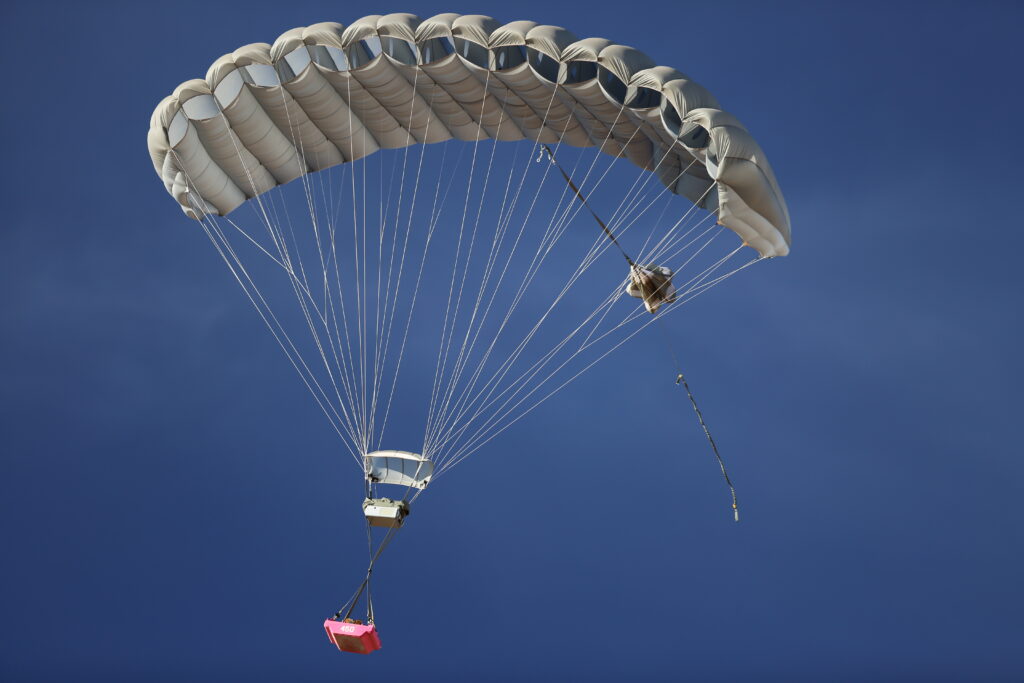
One of the critical logistical tasks during an armed conflict is the ability to resupply units quickly and accurately, directly where they are operating, using cargo parachutes. The accuracy of an airdrop varies considerably depending on the technology used and the release altitude. While conventional methods require large drop zones, modern guided systems using ram-air parachutes achieve accuracy within tens of metres.
The future belongs to GPADS – Guided Precision Aerial Delivery System
The American GPADS system sets the benchmark in this field, using GPS technology together with up-to-date meteorological data in the Mission Planner software. The US Army and Air Force began its joint development in 1993, immediately after GPS reached full operational capability with the complete constellation of the first 24 satellites. The lead developer was RDECOM (Army Research, Development and Engineering Command), with numerous manufacturers of military parachutes and computer equipment, as well as software companies, contributing to the project. When the system was first deployed operationally in 2006 to resupply allied forces in Afghanistan, it revolutionised aerial resupply logistics. Until then, pilots of supply aircraft had to rely solely on drops using round cargo parachutes, flying over the target area at low altitudes (150–800 metres) to ensure accuracy. GPADS allows loads to be released from an altitude of 25,000 feet (approximately 7,600 metres), achieving much greater landing accuracy (within 25 metres), with the option of a release point far from the landing site – tens of kilometres away.
The “brain” of GPADS is an autonomous guidance unit (AGU) containing a GPS receiver. Before the mission, GPADS Mission Planner (GPADS-MP) software calculates the optimum release point based on current meteorological data, the weight of the cargo and the canopy used in the parachute system. After release from the aircraft and a selectable period of stabilised descent, the AGU takes control. It uses a servomotor to operate the parachute’s steering controls and guide the system safely to its target. Releasing cargo from high altitude helps conceal the drop and significantly reduces the risk of the aircraft coming under enemy fire.
Safely across enemy lines
Harnessing the gliding capabilities of modern ram-air parachutes has transformed military strategy from a simple method of vertical descent into a sophisticated capability for long-range insertion. By generating lift and forward speed, these parachutes allow special forces to be deployed far from their objectives and to cross enemy defensive lines undetected.
Modern steerable cargo parachutes use the same principle, transforming military logistics in the process. Gliding systems allow transport aircraft to release cargo at high altitudes (up to 35,000 feet) and at considerable distances from the target. This capability keeps aircraft and their crews beyond the reach of enemy weapons.
The American company Airborne Systems North America currently offers the world’s broadest, most advanced and most reliable range of GPADS systems. As the world’s largest manufacturer of military parachutes, its portfolio also includes a comprehensive range of guided cargo parachutes with payload capacities from 12 kilograms to five tonnes.
Precise landings even without GPS
Over the years, Airborne Systems engineers have significantly refined the original GPADS concept and expanded it with innovative technical solutions, creating their own product family known as GPADS (Guided Precision Aerial Delivery Systems), based on a common system architecture. All models use the same GPS receiver, inertial avionics and flight software. They also share a common user interface and similar packing and assembly procedures. All control components used for deployment remain attached to the parachute and do not require the activation of pyrotechnic release devices after landing.
The GPADS avionics include a commercial GPS receiver for the SAASM (Selective Availability Anti-Spoofing Module), a three-axis inertial measurement unit (IMU) comprising a gyroscope, accelerometer and magnetometer, and a barometric sensor. A major advantage is the ability to determine the target’s position with high accuracy using only inertial and barometric sensors in environments where the GPS signal is jammed.
The most widely used steerable cargo parachute from Airborne Systems North America is the MicroFly II. It was specifically designed to support HAHO/HALO teams: its flight parameters can be adjusted so that parachutists and their equipment land together, at the same time and at the same location. The MicroFly II emphasises ease of use, flexibility and low cost. By combining proven technology with innovative design, Airborne Systems North America has created a safe and reliable cargo delivery system that meets the needs of modern combat units. After release from an aircraft at an altitude of up to 24,500 feet (7,467 m) above mean sea level (AMSL), it can fly autonomously to a pre-programmed target area under a ram-air canopy, without external guidance. Its glide ratio is 1:4, depending on the weight and canopy type. In practice, this means that even in completely calm conditions, a release from an altitude of 7,500 metres allows it to travel four times that distance – 30 kilometres. The system allows the entered data stored in its software to be erased automatically after landing.